- An invisible watermark is a signal embedded in image content, not simply hidden EXIF.
- Detection and payload recovery are different tasks.
- JPEG affects signal values; resize and crop also create geometry and synchronization problems; screenshots can combine several transformations at once.
- A robustness percentage means little unless the test conditions are stated.
Visible watermarks and invisible signals solve different problems
A visible watermark communicates directly to a person. An invisible watermark modifies the image signal so a detector can later search for a known pattern. The mark may only provide a presence signal or may encode an identifier or other payload. It is better understood as a signal-processing system than as hidden metadata.
Robustness is a measured property under specified transformations. It is not a universal promise that the same signal will survive every future app, platform, screenshot or edit.
Where the signal can live
Some watermark systems alter pixel values directly in the spatial domain. Others work in transformed representations such as frequency coefficients. JPEG is particularly relevant because its encoding pipeline transforms image blocks with the discrete cosine transform (DCT) and then quantizes those coefficients.
A frequency-domain watermark can therefore place energy in the same broad signal representation that JPEG later changes. Classic spread-spectrum research helped establish why distributing a signal across perceptually important components can improve resilience compared with a fragile local modification. Modern systems can use very different designs, including learned models, but the core trade-off remains: enough signal to recover, little enough distortion to remain visually acceptable.
Detection is not payload recovery
Presence detection
“Does evidence matching this known signal system appear to be present?” This can be a lower-information task than decoding a message.
Payload recovery
“Can the detector correctly recover the identifier or bit sequence?” Individual symbols must survive enough distortion to decode.
Interpretation
Combine the recovered signal with the image state, metadata and provenance information that is available, so the result has useful context.
This distinction matters whenever a product says “watermark detected.” The statement does not tell you how much payload was recovered, what error rate was observed, or whether the same detector succeeded after a stronger transformation.
JPEG changes signal values
JPEG quantizes frequency coefficients. Re-saving a JPEG quantizes an already encoded signal again. The visible result can look nearly unchanged while small coefficient changes important to a detector are weakened or reshaped.
That does not mean JPEG always destroys invisible watermarks. A design can be optimized for a defined range of compression. But the result depends on image content, embedding method, signal strength, payload, quality setting and detector. “Survives JPEG” is incomplete without those conditions.
Resize changes geometry
Interpolation creates a new sampling grid. Even if signal energy remains, a detector tied to the original geometry can miss it because scale or alignment moved. Robust detection may therefore require synchronization: estimating scale, position, rotation or another transform before the signal can be read.
Crop removes evidence and changes the coordinate frame
A crop physically deletes part of the image. Redundancy can leave signal evidence in the surviving region, but the detector has less data and a new origin. Crop resistance and resize resistance should therefore be measured separately.
A screenshot compounds several transformations
A screenshot creates a new image from rendered pixels. Depending on the workflow, it can combine scaling, display resampling, new dimensions, color changes and a fresh compression path. The original metadata container is not simply copied. Signal survival depends on where the information was carried and how the detector handles the resulting geometry.
How to read a robustness benchmark
Before comparing two watermark claims, look for the test definition. At minimum, a useful benchmark should disclose the variables below.
How many images, what content classes, what resolution and what held-out or development separation?
Signal strength, payload size, keying, error correction and any quality constraints.
Exact JPEG quality, resize factor, crop amount, screenshot path, rotation or platform route.
Presence detection, bit accuracy, full-payload recovery, false-positive rate and the threshold used are not interchangeable metrics.
Does the detector know original geometry? Does it estimate scale/crop? Are tuning images separate from evaluation images?
No percentage without the test envelope.
A result such as “95% survived” is not meaningful by itself. A credible statement needs the population, transformation, detector, metric and threshold. Platform results also need the date and upload route because media pipelines can change.
Robustness, invisibility and capacity pull against each other
Increasing signal energy can help recovery but may make artifacts more visible. Increasing payload adds information burden and can require more redundancy or error correction. Optimizing for imperceptibility alone can leave too little margin for lossy processing. Practical watermark systems balance visual quality, recoverability and capacity rather than maximizing one in isolation.
Watermarks, metadata and provenance are different kinds of information
EXIF/XMP/IPTC live in file structures. A pixel- or frequency-domain watermark lives in the image signal. C2PA Content Credentials are cryptographically signed provenance assertions. One kind of information can disappear while another survives, which is why a useful image review should not collapse them into a single concept of “metadata.”
Use the free monthly allowance to try SIGNA with a photo you already have before deciding whether Pro is useful for you.
What a recovered signal can actually support
How SIGNA approaches invisible signals
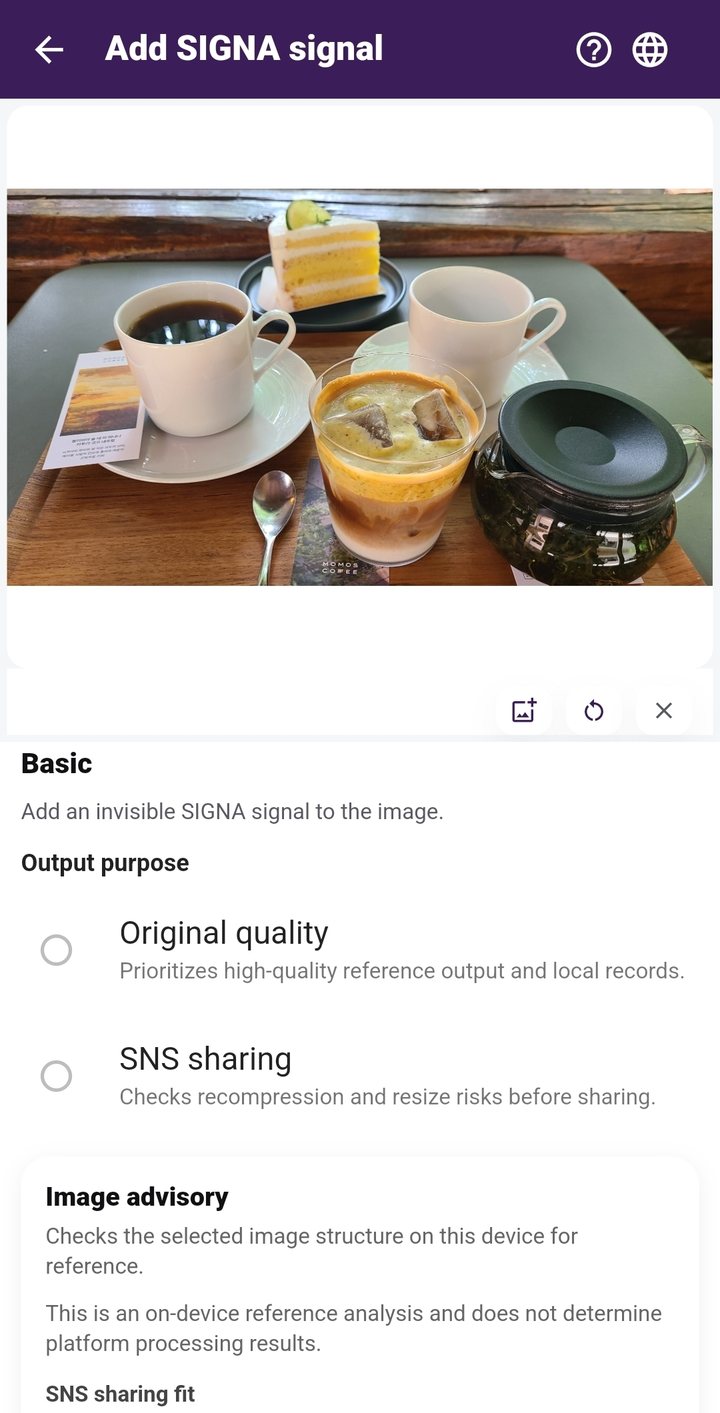
SIGNA can add an invisible SIGNA signal without placing a visible mark over the image. When a visible watermark is applied, SIGNA also adds the invisible SIGNA signal. For JPEG images, SIGNA uses a DCT-based frequency-domain method for signal insertion.
SIGNA’s Inspect flow can present signal-related and image-state information on device. Recompression, resizing, cropping, screenshots and platform processing can affect what remains observable. Those boundaries are part of what the result means.
Primary references and further reading
Cox, Kilian, Leighton & Shamoon — Secure Spread Spectrum Watermarking for Multimedia
Google DeepMind — SynthID overview
Planning to post a photo? See how to choose a watermark before sharing.
Prepare and review images with SIGNA
With SIGNA for Android, add a visible watermark or invisible SIGNA signal before sharing, then come back later to inspect the signal and supported image-state information on your device. Start with the free monthly allowance and see how the workflow fits your own photos.